




































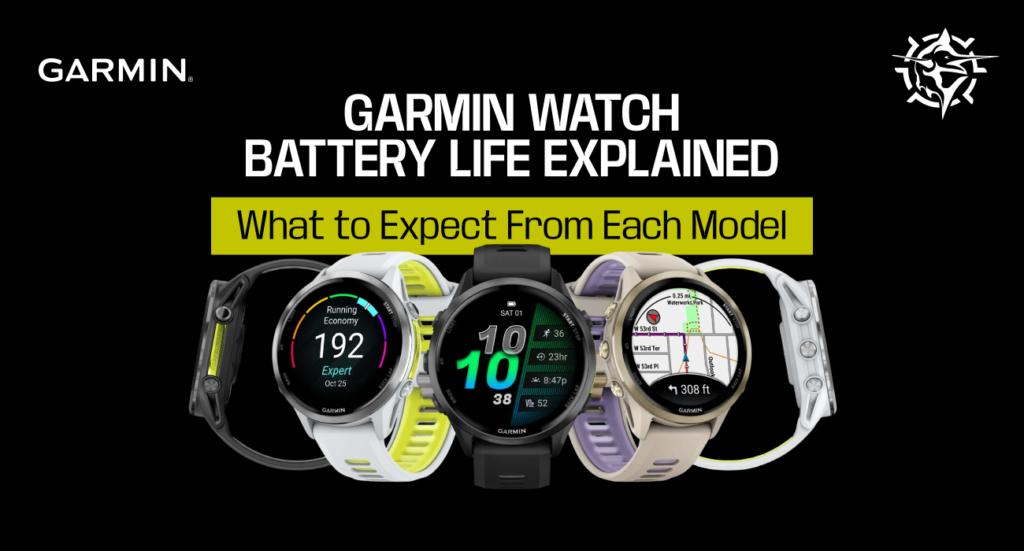

Garmin Battery Life Explained: Smartwatch Mode, GPS Mode and Always-On Display 

One of the most common questions we hear from customers in the UAE is some version of: “How long does the battery actually last?” The honest answer is: it depends entirely on which mode you’re using, and Garmin lists battery life differently for each one. This guide breaks down exactly what each battery mode means, using verified product-page figures, so you can pick a watch that actually matches how you’ll use it.

Why Garmin Lists So Many Different Battery Numbers 

A single Garmin watch might list six or more different battery figures. That’s not marketing inflation — it reflects the fact that GPS tracking, always-on displays, music playback and multi-band satellite positioning all draw very different amounts of power. A watch that lasts 15 days sitting on your wrist as a smartwatch might only last 21 hours if you switch on multi-band GPS for a long trail run with music streaming to your headphones. 

Understanding these modes means you can honestly evaluate whether a watch’s battery life fits your lifestyle rather than being surprised on race day. 

Smartwatch Mode 

This is the baseline figure most people see first, and it represents battery life with the watch doing everyday tasks: showing the time, tracking steps and heart rate in the background, receiving notifications — but without GPS activity tracking running continuously. 

Using the Forerunner range as an example: 

  • Forerunner 570 (42mm): Up to 10 days in smartwatch mode 
  • Forerunner 970 (47mm): Up to 15 days in smartwatch mode 
  • Fenix 8 (47mm AMOLED): Up to 16 days in smartwatch mode 

This is the number to look at if you mainly want a fitness tracker you rarely have to charge, and only use GPS activity tracking occasionally. 

Always-on Display Mode 

Both the Forerunner 570 and 970 offer an optional always-on AMOLED display mode. Keeping the screen constantly lit — rather than dimming or turning off between glances — draws noticeably more power than the standard smartwatch mode.  

GPS Modes: The Real Variable 

This is where battery life changes the most, because satellite tracking is the single biggest power draw on a running or multisport watch. Garmin typically breaks GPS battery life into several sub-modes: 

  • GPS-only GNSS mode: Uses a single satellite system (GPS). Lower accuracy in tough conditions like urban canyons or dense tree cover, but the longest GPS battery life. 
  • SatIQ (AutoSelect) GNSS mode: Garmin’s SatIQ technology automatically switches between satellite modes to balance accuracy and battery life depending on your surroundings. 
  • All-Systems GNSS mode + Multi-Band: Uses multiple satellite systems (GPS, GLONASS, Galileo, and more) simultaneously with multi-band frequency reception for the highest positional accuracy — and the shortest battery life of the standard GPS modes. 

Using the two Forerunner models as a real comparison: 

GPS mode 

Forerunner 570 

Forerunner 970 

GPS-only GNSS 

Up to 18 hours 

Up to 26 hours 

SatIQ (AutoSelect) GNSS 

Up to 14 hours 

Up to 23 hours 

All-Systems GNSS + Multi-Band 

Up to 13 hours 

Up to 21 hours 

For most UAE runners training for 5K to marathon distances, even the shortest of these windows (13 hours on the Forerunner 570) comfortably covers a full marathon with margin to spare. The gap matters more for ultra-distance runners, multi-day adventure racers, or triathletes doing very long training days.  

GPS Mode with Music 

Streaming music to Bluetooth headphones during a GPS activity adds another layer of battery drain on top of GPS tracking itself: 

Mode with music 

Forerunner 570 

Forerunner 970 

GPS-only with music 

Up to 9 hours 

Up to 14 hours 

SatIQ (AutoSelect) with music 

Up to 8 hours 

Up to 13 hours 

All-Systems + Multi-Band with music 

Up to 8 hours 

Up to 12 hours 

If you always run with music or podcasts loaded directly onto your watch, plan around these lower figures rather than the headline GPS-only numbers — the difference can be significant on longer sessions.  

Expedition and Battery Saver modes 

For outdoor-adventure-focused Garmin models like the Fenix and Instinct lines, additional ultra-low-power modes such as Expedition GPS mode and Battery Saver Watch mode can extend battery life dramatically further by reducing GPS sampling frequency and background processing — useful for multi-day hikes or expeditions where charging isn’t an option. 

Solar Charging 

Some Garmin models include a solar charging lens that can extend battery life using ambient light — genuinely useful in the UAE given the amount of sunlight available for most of the year. Whether a specific model you’re considering includes solar charging, and what estimated battery extension it provides, should always be checked on that model’s exact product page, since solar capability is not universal across the range and Garmin states solar gains as estimates rather than guarantees. 

Practical takeaways for UAE buyers 

  1. If you mainly want a daily wearable with occasional GPS runs, focus on the smartwatch-mode battery figure. 
  1. If you’re training for long-distance events, check the All-Systems GNSS + Multi-Band figure specifically — that’s the accuracy mode most serious runners actually use. 
  1. If you run with music, use the “with music” battery figures as your real planning number, not the GPS-only figures. 
  1. If you’re doing multi-day outdoor adventures, look for a model with Expedition mode and, ideally, solar charging, and verify those specific runtime figures on the product page before buying. 
  1. Never assume one battery number applies to every mode. As shown above, the same watch can range from 21 hours to 15 days of runtime depending entirely on what you’re doing with it. 

Related Projects