




































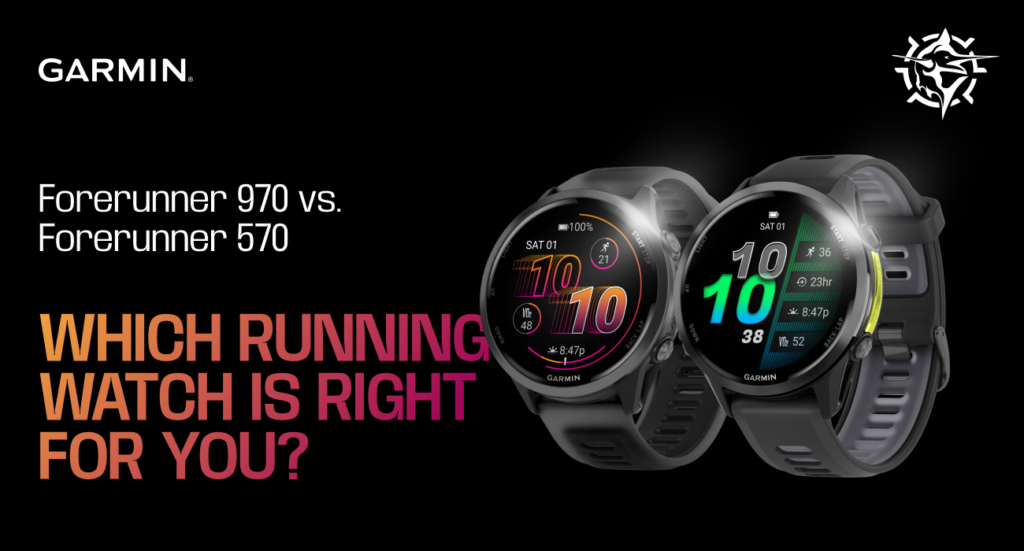

Garmin Forerunner 970 vs Forerunner 570: Which Running Watch Should You Buy?

The Forerunner 970 and Forerunner 570 are two of our most popular Garmin running watches in the UAE right now. Both share an AMOLED touchscreen display and a deep set of running and training metrics, which is exactly why picking between them isn’t obvious. This comparison uses the exact specifications on each product page to help you decide which one actually fits your training. 

The Short Answer 

If you want the longest battery life, built-in mapping, a flashlight, and you’re training for longer distances like marathons or ultras, the Forerunner 970 is the better buy. If you want a lighter watch, a smaller 42mm case, and the same core training-science features at a lower price, the Forerunner 570 is the smarter choice for most 5K-to-10K-focused runners. 

Price 

At the time of writing this blog: 

  • Forerunner 570 (42mm): AED 2,239.00 
  • Forerunner 970 (47mm): AED 3,059.00 

That’s roughly an AED 800 gap, which buys you a meaningfully bigger battery, a titanium bezel, sapphire crystal lens, and mapping. Prices should always be reconfirmed on the linked product page before purchase, since offers and stock change. 

Design and Physical Build 

The Forerunner 570 is the smaller of the two, with a 42.4 x 42.4 x 12.9mm case, a 1.2-inch (30.4mm) AMOLED display at 390 x 390 pixel resolution, an aluminium bezel and Corning Gorilla Glass 3 lens, weighing 42g. It uses 20mm Quick Release bands. 

The Forerunner 970 steps up to a 47 x 47 x 12.9mm case with a larger 1.4-inch (35.3mm) AMOLED display at 454 x 454 pixels, a titanium bezel, and a sapphire crystal lens for added scratch resistance — a genuinely useful upgrade if you’re training outdoors around UAE trail terrain or gym equipment. It weighs 56g and uses 22mm QuickFit bands. Both models have a built-in speaker and microphone for calls via a paired smartphone. 

If wrist size or lightness is a priority — many runners specifically prefer a smaller watch for 5K/10K racing — the 570’s 42mm case is the more comfortable option. If you want a bigger, more legible display for glancing at data mid-long-run, the 970 wins. 

Battery Life: The Biggest Practical Difference 

This is where the two watches really diverge: 

Mode 

Forerunner 570 (42mm) 

Forerunner 970 (47mm) 

Smartwatch mode 

Up to 10 days 

Up to 15 days 

GPS-only GNSS 

Up to 18 hours 

Up to 26 hours 

SatIQ (AutoSelect) GNSS 

Up to 14 hours 

Up to 23 hours 

All-Systems GNSS + Multi-Band 

Up to 13 hours 

Up to 21 hours 

GPS-only with music 

Up to 9 hours 

Up to 14 hours 

All-Systems + Multi-Band with music 

Up to 8 hours 

Up to 12 hours 

For context: a sub-4-hour marathon fits comfortably within either watch’s multi-band GPS window. But for back-to-back long training weekends, ultra-distance events, or multi-day race weeks without daily charging, the 970’s extra runway is a real advantage. Runners doing shorter, more frequent sessions are unlikely to notice the difference day to day. 

Storage and Memory 

The Forerunner 970 includes 32GB of memory, versus 8GB on the Forerunner 570. This matters mainly for offline music storage and, on the 970, for downloadable maps — a feature the 570 does not carry. 

Mapping and Navigation 

This is one of the clearest feature splits. The Forerunner 970 includes built-in mapping support along with ClimbPro Ascent Planner, Up Ahead, NextFork navigation, downloadable cartography, and preloaded road, trail and ski resort maps. The Forerunner 570 focuses on point-to-point navigation, breadcrumb trail, TracBack, and round-trip course creation, but doesn’t carry the same built-in mapping and NextFork/Up Ahead navigation tools as the 970. 

If you regularly train on unfamiliar trails, or want full route visuals on your wrist rather than just breadcrumb lines, this is a strong point in the 970’s favour. 

Built-in Flashlight 

The Forerunner 970 includes a built-in LED flashlight; the Forerunner 570 does not. For UAE runners heading out before sunrise to beat the heat, this is a small but genuinely practical difference. 

Training and Running Science Features 

Both watches carry Garmin’s core running-science toolkit: Training Readiness, Training Status (Improved), Training Load, Load Focus, Recovery Time, HRV Status, VO2 Max (run and trail run), Real-Time Stamina, Endurance Score, Hill Score, Race Predictor, PacePro Pacing Strategies, Heat and Altitude Acclimation, and Daily Suggested Workouts. Running dynamics — ground contact time, vertical oscillation, cadence, stride length — appear on both. 

In other words, from a pure training-science standpoint, you are not sacrificing meaningful running metrics by choosing the more affordable Forerunner 570. The gap between these two watches is about battery, mapping, materials and screen size — not the underlying training intelligence. 

Multisport and Triathlon 

Both watches offer full multisport activity profiles including triathlon, duathlon, brick sessions, pool and open-water swimming, with SWOLF, stroke detection and underwater wrist-based heart rate. For triathletes, the deciding factor again comes back to battery life on race day: the 970’s longer GPS runway gives more comfort margin for longer-course events.  

Which One Should You Buy? 

  • Choose the Forerunner 570 if you’re primarily training for 5K to half-marathon distances, prefer a smaller and lighter watch, and want to save roughly AED 800 without giving up core training-science features. 
  • Choose the Forerunner 970 if you’re marathon or ultra training, want built-in mapping and a flashlight, need the longest possible GPS battery runway, or simply want the larger display and more premium materials (titanium bezel, sapphire lens). 

Both watches are available from us online and in-store. 

Where To Buy in the UAE 

Compare both watches in person at AMIT Retail, Garmin’s Official Store/Distributor: 

Or shop both models directly at amitretail.com. Always confirm current price, stock and colourway availability on the linked product page before purchasing.  

Related Projects